THE CONNECTION BETWEEN PERSONAL HEALTH AND ENVIRONMENTAL HEALTH
by
evaldomaciel@hotmail.com
Share Article
A 2026 Perspective on Sustainable Wellness and Conscious Supplementation
THE CONNECTION BETWEEN PERSONAL HEALTH AND ENVIRONMENTAL HEALTH
A 2026 Perspective on Sustainable Wellness and Conscious Supplementation. Discover how your health choices impact the planet. Understand the connection between personal wellness and environmental sustainability in 2026.
The Great Convergence of 2026
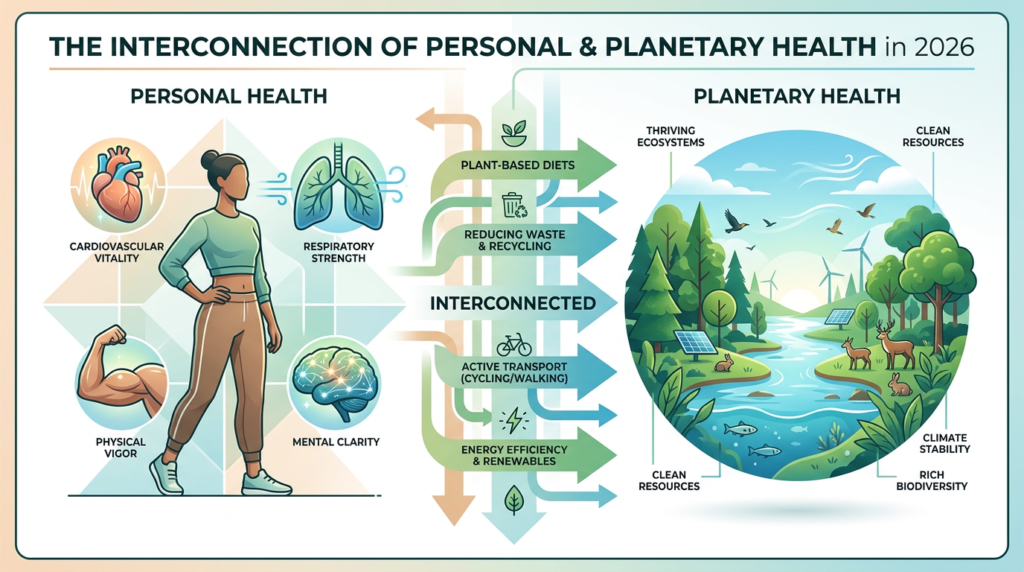
For decades, we treated our bodies and our planet as two separate entities. We went to the gym to strengthen our muscles while the air outside grew heavier. We took vitamins to boost our immunity while the soil that grew our food lost its vitality. But as we stand here in April 2026, that illusion of separation has finally dissolved. We have entered the era of The Great Convergence.
Today, being “healthy” is no longer just about your blood pressure or your body fat percentage. It is about the quality of the water you drink, the purity of the air you breathe, and the integrity of the supply chains that bring nutrients to your table. In 2026, personal wellness is environmental wellness. You cannot have a healthy body on a sick planet.
This article explores why this connection has become the defining theme of our decade. We will look at how your daily choices—from the food you eat to the supplements you take—create a ripple effect that either heals or harms the world around you. More importantly, we will show you how to align your personal health goals with the restoration of our Earth.
“The human body is not an island; it is a biological outpost of the Earth’s ecosystem. When the ecosystem thrives, we thrive.”
2. The Uncomfortable Truth: Your Health Depends on Planet Health
In 2026, the data is undeniable. We are seeing a direct correlation between environmental degradation and the rise of modern health challenges. The “Uncomfortable Truth” is that our internal biology is a mirror of our external environment. If the environment is toxic, our cells struggle to maintain balance.
Consider the soil crisis. Over the last century, intensive farming has stripped the Earth’s crust of essential minerals like magnesium, selenium, and zinc. As a result, even a “perfect” diet today may provide significantly fewer nutrients than the same diet did fifty years ago. We are overfed but undernourished because our soil is exhausted.
Furthermore, the presence of microplastics and endocrine disruptors in our water systems has reached a tipping point. These environmental pollutants don’t just stay “out there”—they enter our bloodstream, affecting our hormonal balance and metabolic health. In 2026, protecting the environment is the most effective form of preventive medicine we have.
Air Quality and Respiratory Resilience: Urban dwellers are increasingly prioritizing antioxidants to combat the oxidative stress caused by lingering particulate matter.
Water Purity: The shift toward advanced filtration isn’t just a luxury; it’s a necessity to remove synthetic residues.
Nutrient Density: The movement toward regenerative agriculture is driven by the need to restore the mineral content of our daily food.
3. How Your Health Choices Impact the Planet
Every time you make a health-related purchase, you are casting a vote for the kind of world you want to live in. In 2026, the “Conscious Consumer” has moved from the fringe to the mainstream. We now understand that our quest for vitality shouldn’t come at the expense of the Amazon rainforest or the health of our oceans.
3.1 Supplementation and Responsible Sourcing
The supplement industry has undergone a massive transformation. In the past, many vitamins and minerals were sourced with little regard for their origin. Today, Responsible Sourcing is the gold standard. For example, instead of harvesting wild fish for Omega-3s—which depletes marine ecosystems—we are seeing a massive shift toward algae-based Omega-3s. This provides the same essential fatty acids directly from the source, leaving the fish in the sea.
Responsible sourcing also means ensuring that botanical ingredients, like Ashwagandha or Turmeric, are grown using organic practices that don’t poison the local groundwater or exploit the farmers who harvest them.
3.2 Plant-Based Nutrition: Efficiency and Vitality
By 2026, plant-based nutrition is no longer just a dietary preference; it’s a global sustainability strategy. Producing plant-based proteins requires significantly less water and land compared to animal-based sources. From a health perspective, a diverse plant-rich diet provides the fiber and phytonutrients necessary for a robust microbiome. When we eat lower on the food chain, we reduce our environmental footprint while flooding our bodies with anti-inflammatory compounds.
3.3 Conscious Supplement Consumption
The “more is better” philosophy of the early 2000s has been replaced by Precision Wellness. Conscious consumption means taking only what your body actually needs. This reduces waste—both in terms of packaging and the metabolic load on your kidneys and liver. In 2026, we use diagnostic tools to identify specific deficiencies, ensuring that every capsule we swallow serves a purpose for our health and represents a minimal draw on planetary resources.
4. Why 2026 is the Year of Change
Why is this happening now? Why didn’t we see this shift in 2016 or 2020? Several factors have converged to make 2026 the definitive year for sustainable wellness.
The Transparency Revolution: Blockchain technology now allows consumers to scan a QR code on a supplement bottle and see the exact farm where the ingredients were grown, the date of harvest, and the carbon footprint of the shipping process. Radical transparency has eliminated “greenwashing.”
Regulatory Shifts: New global standards implemented in early 2026 now require health companies to account for their “Scope 3” emissions. This has forced the industry to move away from single-use plastics and toward compostable or infinitely recyclable packaging.
The Wellness Awakening: After years of global health volatility, people have realized that true immunity is built through a lifestyle that is in harmony with nature, not one that tries to bypass it with synthetic shortcuts.
5. Sustainable vs. Conventional Supplementation
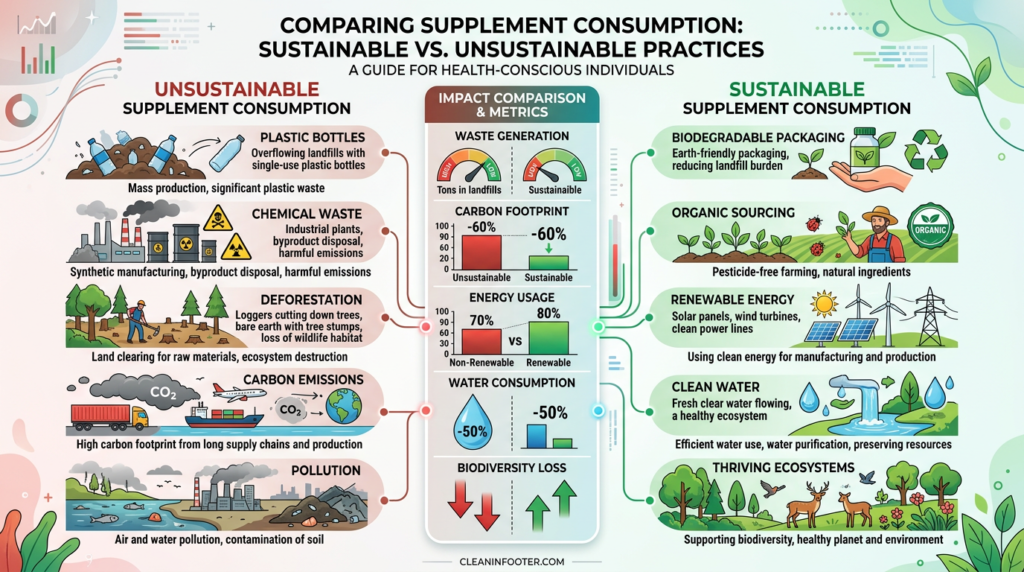
To help you navigate the market in 2026, we have outlined the key differences between the old way of doing things and the new, sustainable standard.
Aspect
Conventional Supplementation
Sustainable Supplementation (2026)
Ingredient Sourcing
Mass-market, unknown origins
Regenerative farms & ethical wild-crafting
Packaging
Single-use virgin plastic
Compostable, glass, or recycled aluminum
Carbon Footprint
High (global shipping without offsets)
Low (localized production & carbon neutral)
Transparency
Proprietary blends (hidden details)
Full traceability via Blockchain/QR codes
Purity
May contain heavy metals/fillers
Third-party tested for 200+ contaminants
Waste
High manufacturing byproduct waste
Zero-waste manufacturing processes
Social Impact
Profit-only focus
Fair trade and B-Corp certified
Bioavailability
Synthetic isolates
Whole-food based or fermented for absorption
Testing
Minimal required by law
Rigorous, transparent batch testing
Long-term Cost
Cheap upfront, high environmental cost
Fair price reflecting true cost of quality
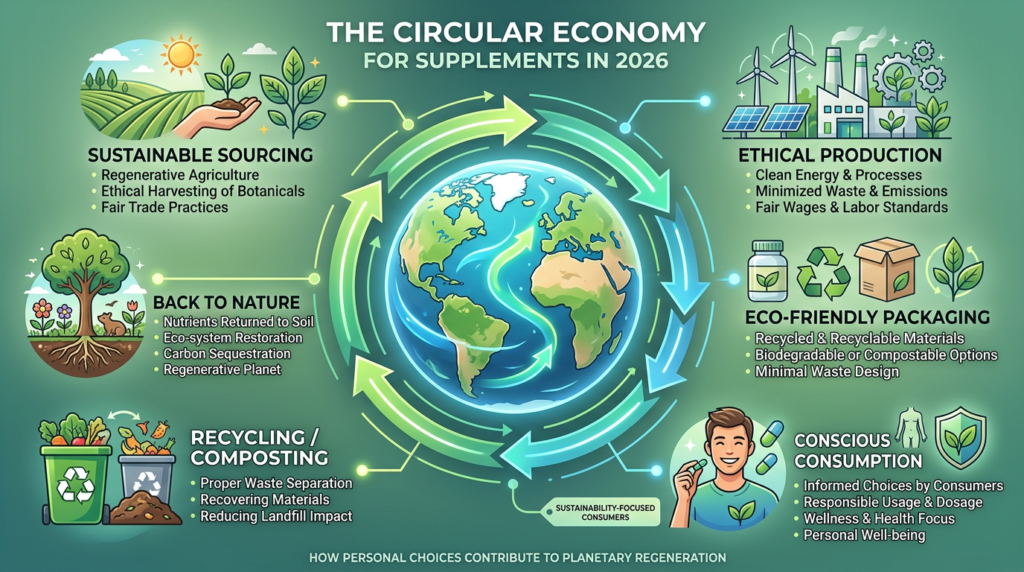
6. The Regenerative Cycle: Circular Economy in Action
In 2026, we are moving beyond “sustainability” (which implies maintaining the status quo) toward regeneration (which implies making things better). In the world of health, this looks like a circular economy.
Imagine a supplement company that uses the leftover husks of organic grapes from the wine industry to create potent antioxidant extracts. Or a brand that uses mushroom mycelium to create biodegradable shipping coolers. This is the circular economy in action: nothing is wasted, and every byproduct becomes the “food” for another process. When you support these companies, you are participating in a regenerative cycle that heals the Earth while it nourishes you.
Note: Regeneration is the highest form of sustainability. It doesn’t just “do less harm”—it actively restores the soil, the water, and the air.
7. How You Can Start Today: 5 Practical Steps
Transitioning to a sustainable health routine doesn’t have to happen overnight. Here are five actionable steps you can take starting today, April 22, 2026.
Audit Your Pantry: Look at your current supplements. Are they in plastic bottles? Do they list their country of origin? When you finish them, replace them with brands that use sustainable packaging.
Choose Algae over Fish: If you take Omega-3s, switch to a high-quality algae oil. It’s cleaner, more sustainable, and just as effective.
Support B-Corps: Look for the “B-Corp” logo on health products. This certification ensures the company meets the highest standards of social and environmental performance.
Reduce Your “Supplement Waste”: Focus on high-quality, bioavailable forms of nutrients. If your body can’t absorb it, it’s just going down the drain—literally.
Educate Your Circle: Share what you’ve learned about the connection between soil health and human health. Awareness is the first step toward collective change.
8. Sustainability Checklist for Supplements
Use this checklist before your next purchase to ensure your health choices align with your environmental values.
Checklist Item
Yes / No
Is the packaging plastic-free or made from 100% recycled materials?
[ ]
Does the brand provide a COA (Certificate of Analysis) for purity?
[ ]
Are the ingredients sourced from regenerative or organic farms?
[ ]
Is the company transparent about its carbon footprint?
[ ]
Does the product avoid synthetic fillers and artificial colors?
[ ]
Is the brand certified by a third party (B-Corp, FSC, Non-GMO)?
[ ]
9. FAQ: Frequently Asked Questions
1. Are sustainable supplements more expensive?
Initially, they may have a slightly higher price point because they account for the “true cost” of ethical labor and environmental protection. However, because they are often more bioavailable and potent, you may need to take less, making them more cost-effective in the long run.
2. Is algae oil really as good as fish oil?
Yes. In fact, fish get their Omega-3s by eating algae. By going straight to the source, you get a highly concentrated dose of DHA and EPA without the risk of heavy metal contamination often found in large predatory fish.
3. What does “Regenerative Agriculture” mean for my vitamins?
It means the plants used to make your vitamins were grown in soil that is being actively restored. This results in plants with higher phytonutrient density and a lower environmental impact.
4. Can I recycle my supplement bottles?
It depends on the material. In 2026, many leading brands have moved to compostable pouches or glass jars with refill programs. Always check the label for specific disposal instructions.
5. How do I know if a brand is “Greenwashing”?
Look for specific certifications and data. If a brand uses vague terms like “natural” or “eco-friendly” without providing data, third-party audits, or traceability, they may be greenwashing.
6. Does my diet really affect the planet that much?
Absolutely. Food production is one of the largest drivers of environmental change. Shifting toward a plant-heavy, sustainably sourced diet is one of the most impactful things an individual can do for the Earth.
10. Conclusion: A Future of Harmony
As we move further into 2026, the path forward is clear. We can no longer afford to pursue health in a vacuum. The vitality of our cells is inextricably linked to the vitality of our forests, our oceans, and our soil. When we choose to nourish ourselves with integrity, we are not just “taking vitamins”—we are participating in the healing of our world.
The choice is yours. Every meal, every supplement, and every daily habit is an opportunity to strengthen the bond between your personal health and the health of the environment. Let’s choose a future where both can thrive.
In this article, you’ll discover practical nutrition strategies based on science and real cases that led to transformations like 15kg of fat lost in 90 days for clients who applied these steps. I’m a content specialist for health blogs, inspired by Alex Hormozi’s methodology of delivering 100x value before asking for anything.